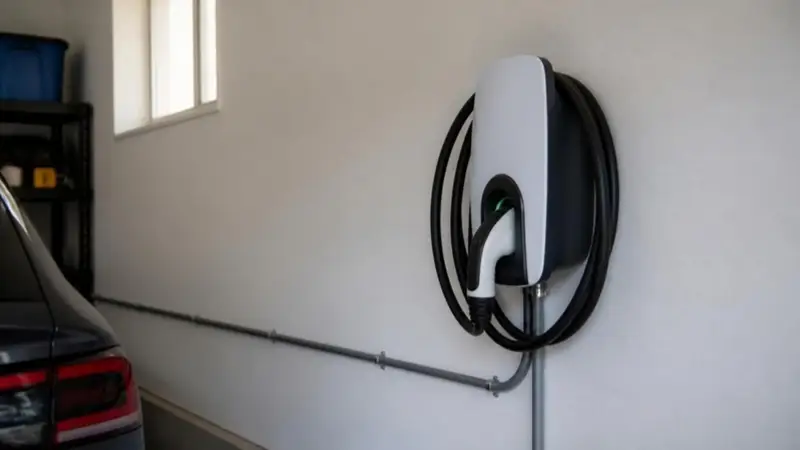
What Is a Level 2 Home Charger?
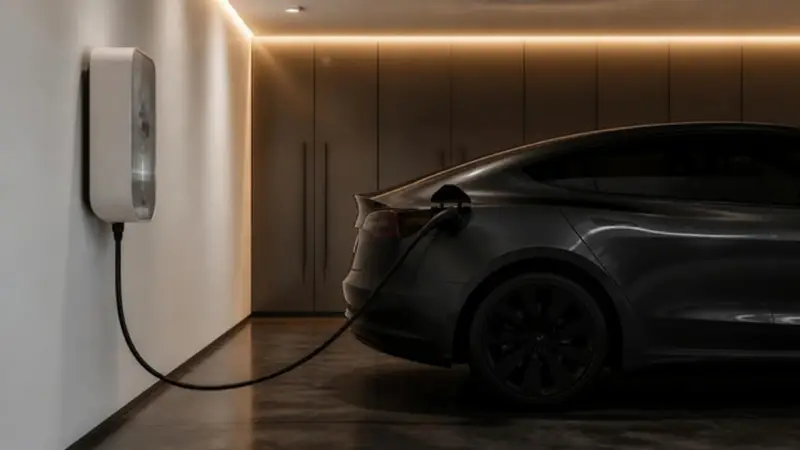
A Level 2 home charger is a wall-mounted charging unit (technically EVSE, electric vehicle supply equipment) powered by a dedicated 240-volt circuit, the same voltage used by an electric dryer or range. Depending on the charger and vehicle, it adds roughly 20–40+ miles of range per hour, compared with a few miles per hour from a standard 120-volt outlet.
For most drivers, that difference decides whether an EV feels effortless. A Level 2 charger restores a typical day's driving in a few hours overnight, so you start each morning with the charge you need without planning trips around public stations. Installing one is the most common project behind EV charger installation in Reynoldsburg, and for a garage near the panel it's often a single-day job.
Signs You're Ready for a Level 2 Charger
- Your car isn't reaching a full charge overnight on the 120-volt cord that came with it.
- You drive more than a short daily commute, or you make regular trips to Columbus or beyond.
- You've bought, or are about to buy, a fully electric vehicle rather than a plug-in hybrid.
- Two drivers in the household share EV charging time.
- You want to schedule charging for off-peak hours under a time-of-use rate.
Hardwired vs. NEMA 14-50 Outlet Installations
There are two ways to connect a home charger, and both are legitimate:
Hardwired charger
The charger is wired directly to its circuit. This allows the highest home output (up to 48 amps on a 60-amp circuit), removes the outlet as a point of wear and heat, and is the setup most manufacturers recommend for daily high-power use. Outdoor installations are usually hardwired.
Plug-in charger on a NEMA 14-50 outlet
A 240-volt outlet lets you unplug and replace the charger or take it with you when you move. The trade-offs: output is limited to 40 amps on a 50-amp circuit, and the outlet must be a heavy-duty, industrial-grade receptacle suited to repeated continuous loads. Inexpensive outlets can overheat under hours of EV charging. Current code generally requires GFCI protection for these outlets, which the electrician will account for. Our NEMA 14-50 vs. hardwired guide compares the two in detail.
Choosing the Right Charger Size
EV charging is a continuous load, so the breaker must be rated at 125% of the charger's output. Bigger isn't always better. Your car's onboard charger limits how much it can accept, and a smaller circuit can avoid a panel upgrade. See what size breaker you need for wire sizes too.
| Charger output | Breaker size | Approx. power | Good fit for |
|---|---|---|---|
| 24A | 30A | ~5.8 kW | Plug-in hybrids, low daily mileage, tight panels |
| 32A | 40A | ~7.7 kW | Most commuters. A common balance of speed and cost |
| 40A | 50A | ~9.6 kW | Larger batteries, NEMA 14-50 plug-in chargers |
| 48A | 60A (hardwired) | ~11.5 kW | Vehicles with 11 kW+ onboard chargers, high mileage |
If your panel can't comfortably support the size you want, see our guide to panel upgrades and load management before assuming you need a new service.
Universal Charger Setup: J1772, NACS and Mixed-EV Households
North American EVs are moving from the J1772 connector to NACS (standardized as SAE J3400), the connector Tesla introduced. During the transition, households often have one of each. Options include a universal charger with a built-in adapter, a charger with a swappable cable, or a standard charger plus the adapter supplied by the automaker. The electrical installation is the same for all of them, so choose the connector that suits your household's vehicles over the next several years.
If one of your vehicles is a Tesla, see the dedicated Tesla Wall Connector installation page, which covers the Universal Wall Connector and power sharing.
How a Home Charger Installation Works
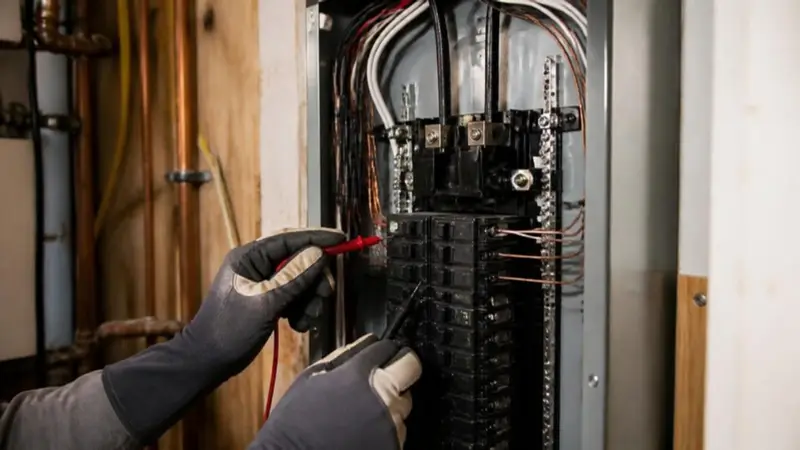
- Assessment. The electrician reviews your panel (often from photos first), the charger location, and the route between them, and runs a load calculation.
- Quote and permit. You receive a written scope and price. The contractor applies for the electrical permit with the building department that has jurisdiction.
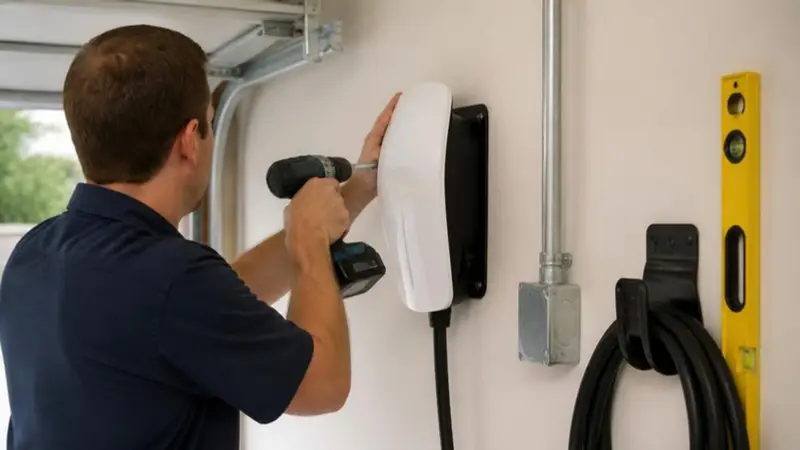
- Installation. A two-pole breaker is added, conductors are run in conduit or approved cable, and the charger or outlet is mounted at a convenient height near where the charge port parks.
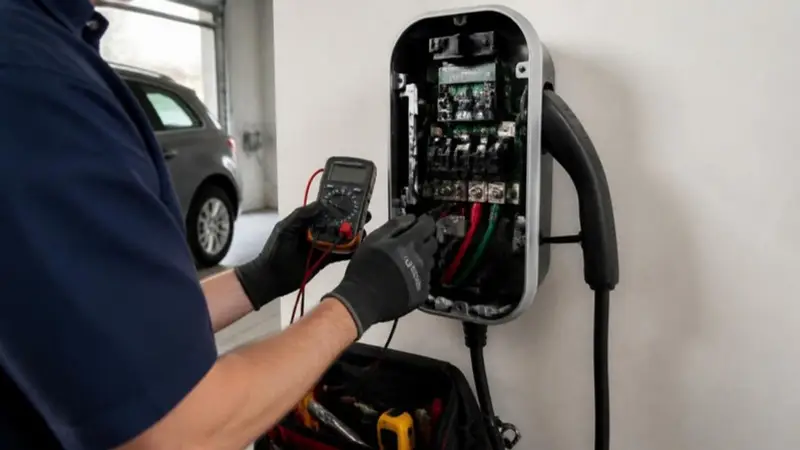
- Commissioning. The charger's amperage is set to match the circuit, and Wi-Fi and app setup is completed if the charger supports it.
- Inspection. The local inspector checks the work, and after that the job is complete.
Garage, Driveway and Detached-Building Installations
Attached garages are the most straightforward, especially when the panel is on the garage wall or in an unfinished basement below. Exterior walls and driveways need an outdoor-rated charger (NEMA 3R or 4) and weather-rated fittings. Consider cable reach and snow clearing when you choose the spot. Detached garages and outbuildings usually need an underground feeder in conduit, and sometimes a subpanel. Trenching distance, depth and what the route crosses (driveway, patio, landscaping) have a big effect on cost. This is common on larger lots, as described on our Pataskala page.
What a Level 2 Installation Costs Depends On
We don't publish prices because every house is different, and only the installer can quote your job. The biggest cost drivers are the distance and routing from the panel to the charger, whether the panel has capacity and breaker space, the charger's amperage (a 60-amp circuit needs heavier wire), indoor versus outdoor mounting, and permit fees. The charger itself is usually priced separately. You can often speed up the quote by texting or emailing the installer photos of your panel label, the main breaker and the planned charger spot.
For a broader look at charging options and the local permitting and utility context, see our overview of home and commercial EV charger installation in Reynoldsburg, OH.
Why a Licensed Electrician Should Do It
A Level 2 charger draws high current for hours at a time. Loose terminations, undersized wire, the wrong breaker or a cheap outlet can overheat, and those problems often don't show until months later. A licensed contractor sizes the circuit correctly, pulls the permit, and gets the work inspected. Many charger manufacturers also require qualified installation to keep the hardware warranty valid. Whoever handles your EV charger installation in Reynoldsburg, ask for their Ohio contractor license number.