The Short Answer
The cost of installing a home EV charger in Ohio depends far more on your house than on the charger. The four biggest factors are the distance and routing from the electrical panel to the charger, whether the panel has spare capacity and breaker space, the charger's amperage, and permit fees. A garage charger mounted near a panel with room to spare is the least expensive job. Detached garages, finished walls and service upgrades add the most.
That's why reputable installers rarely quote a flat price sight-unseen. Any number given before someone has seen your panel is a guess. This guide explains what goes into a real quote so you can compare them properly. For the services behind these quotes, see our overview of EV charger installation in Reynoldsburg.
The Four Parts of an Installation Quote
1. Charger hardware
The Level 2 unit itself. Often listed separately, and some homeowners buy their own. Price varies with brand, amperage, cable length, smart features and outdoor rating.
2. Circuit materials & labor
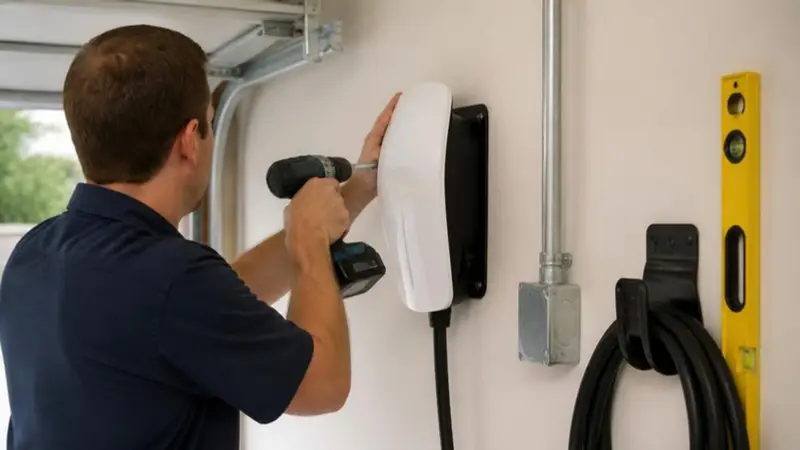
A two-pole breaker, copper conductors sized for the load, conduit or cable, fittings, mounting and the labor to route it all. This is usually the largest and most variable line.
3. Permit & inspection
Fees set by the building department with jurisdiction over your address, plus the installer's time to file and meet the inspector. See our Ohio permit guide.
4. Electrical upgrades (if needed)
A subpanel, load management device, panel replacement or service upgrade when capacity is short. Not every job needs one. See panel upgrades & load management.
Three Common Scenarios
Most Reynoldsburg-area installations fall into one of these patterns. They're listed from least to most involved:
| Scenario | Typical setup | What adds cost |
|---|---|---|
| Straightforward | Panel on the garage wall or in an unfinished basement below, spare capacity, a 32A or 40A charger a short run away | Very little beyond the circuit, charger and permit |
| Moderate | Panel on the far side of the house, finished basement or walls, or a 48A charger needing a 60A circuit and heavier wire | Longer runs, heavier copper, fishing wire through finished spaces, drywall patching |
| Complex | Detached garage or outbuilding, outdoor pedestal, full panel or 100-amp service in an all-electric home | Trenching and underground conduit, subpanels, load management or a service upgrade with utility coordination |
Larger lots with detached garages, which are common in places like Pataskala, often land in the complex category because of trench length. Newer subdivision homes with a 200-amp panel beside the garage often land in the straightforward one.
Line Items People Don't Expect
- Drywall repair and painting after fishing wire through finished walls. Some installers patch, others leave it to you.
- GFCI protection for outlet-based installations, which often requires a more expensive breaker.
- A load management device when the panel is close to capacity. It usually costs far less than a service upgrade.
- Utility coordination for service upgrades, since AEP Ohio or your cooperative has to schedule the disconnect and reconnect.
- Wi-Fi extension to a garage with weak signal if you want app control or firmware updates.
- HOA approval for exterior-mounted chargers in communities with design rules.
How to Lower the Cost (Without Cutting Corners)
- Choose the right amperage, not the biggest. If your car's onboard charger accepts 7.7 kW, a 32A charger on a 40A circuit charges it just as fast as a 48A unit, with lighter wire and less panel capacity. See breaker sizing.
- Mount the charger close to the panel when the parking layout allows it. A slightly longer charging cable is cheaper than a longer circuit.
- Ask about load management before agreeing to a service upgrade.
- Plan future work together. If a heat pump, induction range or second EV is coming, size the electrical work once.
- Get two or three written quotes that list the charger, circuit size, wire, permit and warranty the same way, so you're comparing like with like.
Don't try to save money by skipping the permit or using an outlet and wiring that aren't rated for continuous EV loads. Those shortcuts cause most charging-related electrical problems.
How to Get an Accurate Quote Faster
Most installers can quote from photos. Send these:
- The electrical panel with the door open, showing all breakers
- The label inside the panel door and the main breaker rating
- Where you want the charger, and where you park
- The route between the panel and the charger (basement ceiling, garage wall and so on)
- Your vehicle make and model, and the charger if you already own one
For incentives that may offset part of the cost in 2026, see our Ohio tax credits and rebates update. Ready to price your own project? Our Level 2 home charger installation page explains the process step by step.