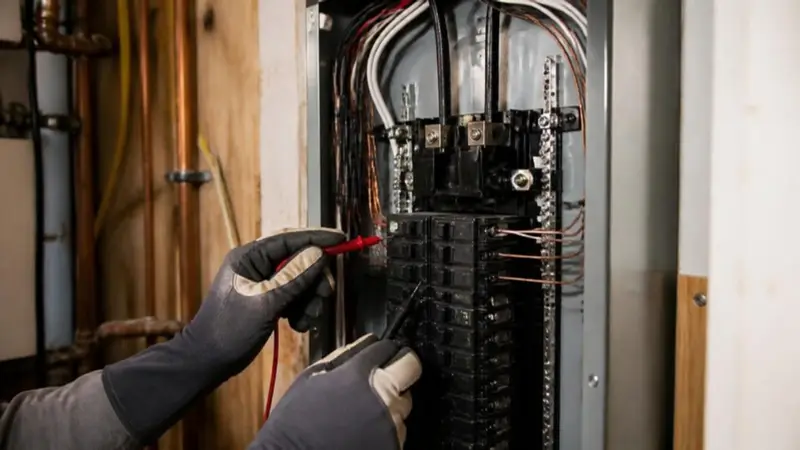
Do You Need a Panel Upgrade for an EV Charger?
Not always. Whether you need an upgrade depends on a load calculation, not just on how full the panel looks. Many homes can add a Level 2 charger as is. Others need a lower charger setting, a load management device, a subpanel, or, when capacity is truly short, an upgraded service, often to 200 amps.
This is the question that most often changes the scope and price of EV charger installation in Reynoldsburg, OH. It's worth understanding the options before you accept an upgrade quote, or before you assume the charger will be a simple add-on.
How Electricians Decide: The Load Calculation
A load calculation (based on the National Electrical Code method) estimates your home's demand from its square footage, fixed appliances, cooking equipment, dryer, water heater, and heating and cooling systems. The electrician then adds the EV charger at 125% of its output and compares the total to your service rating.
Two homes with identical 100-amp panels can get different answers. A home with gas heat, a gas range and a gas water heater may have room for a charger. An all-electric home with a heat pump, electric range and electric water heater often won't.
Signs Your Panel May Be a Constraint
- Your main breaker is 100 amps or less, and the home has electric heat or several large electric appliances.
- There's no open space for a two-pole breaker, and the panel doesn't allow tandem breakers.
- Breakers already trip when several large appliances run at once.
- The panel is an older or discontinued model that an electrician flags for replacement on safety grounds.
- You're planning other electrical additions, such as a heat pump, hot tub, induction range or shop equipment.
Your Options, From Simplest to Largest
| Option | What it is | When it fits |
|---|---|---|
| Lower charger setting | Install a 32A or 24A charger circuit instead of 48A | Daily mileage is moderate and overnight charging is enough |
| Smart load management | A device or charger feature that monitors household demand and throttles charging | Capacity is close, but peaks are brief |
| Power-sharing chargers | Two chargers split one circuit | Two-EV households with limited breaker space |
| Subpanel | A new panel fed from the main to add breaker space | Space is the problem, not total capacity |
| Panel replacement | New panel at the same service size | The panel is outdated or unsafe, or has no usable space |
| Service upgrade | Increase the service (commonly to 200A), including the meter base and utility coordination | The load calculation shows real shortfall, or other electrification is planned |
How Smart Load Management Works
A load management system uses current sensors on your main service conductors to watch total household demand in real time. When demand approaches the limit, for example when the dryer, oven and air conditioning are all running, it automatically reduces or pauses EV charging and then resumes when demand drops. Because most EV charging happens overnight, when household demand is lowest, the car usually still ends up fully charged.
The National Electrical Code recognizes these energy management systems as a way to size EV circuits without exceeding the service rating. Some chargers have load management built in with an add-on sensor, and standalone devices are also available. Ask your installer which approach they use and whether it's permitted as part of the installation.
What a Service Upgrade Involves Around Reynoldsburg
A service upgrade replaces the panel and usually the meter base and service entrance conductors. The electrician pulls the permit, and the utility has to disconnect and reconnect power and may need to upgrade its service drop. Much of the area is served by AEP Ohio, while some addresses in Licking and Fairfield counties are on electric cooperatives. Your electrician typically coordinates the schedule. Expect the upgrade to take longer than a standard charger installation, because utility scheduling and inspections set the pace.
If you're considering other upgrades soon, such as a heat pump, induction cooking or a second EV, plan them together so the service is sized once. Homeowners in Gahanna and other established neighborhoods with older panels often find this approach worthwhile.
Cost Considerations
Load management and lower-amperage circuits usually cost far less than a service upgrade. A service upgrade's cost depends on the new service size, meter base and service entrance work, panel location, any grounding or bonding corrections, and utility requirements. Because these vary so much between homes, get a written quote that separates the charger circuit from the panel or service work. Our EV charger installation cost guide explains what else a quote should include.
Once your panel question is answered, the rest of the project follows our Level 2 home charger installation process. For the bigger picture, visit our overview of EV charging installation services in Reynoldsburg.
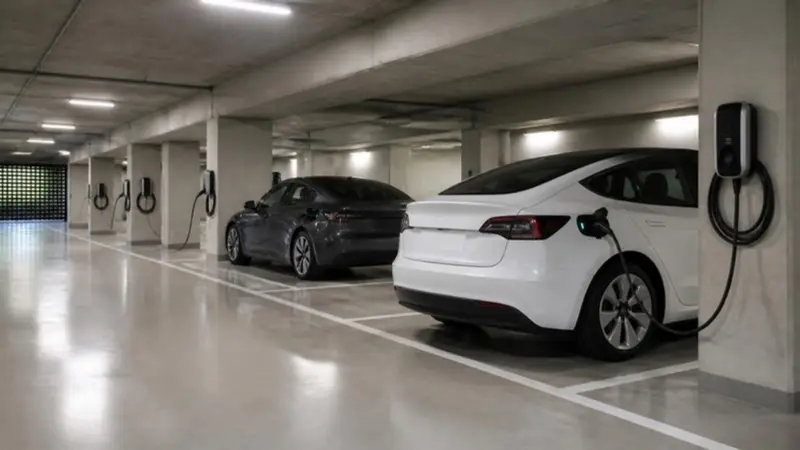
Load Management for Businesses and Multi-Unit Buildings
The same principle scales up. Networked charging systems can share limited building capacity across many ports, which often avoids expensive transformer or service upgrades. See apartment, condo and HOA charging and commercial charging stations for how this works in larger buildings.