The Short Answer
In a condo, HOA or apartment, you generally need written approval from the board or landlord before a charger is installed. Expect an agreement that covers who pays for installation and electricity, insurance, a licensed contractor, and removal if you move. For boards, the main decisions are assigned versus shared chargers and how to bill for electricity.
The electrical side follows the same rules as any EV charger installation in Reynoldsburg: a dedicated circuit, a load calculation and a permit. What's different is the paperwork, the shared service and the question of who pays.
What Ohio Law Says
Ohio condominiums are governed by Ohio Revised Code Chapter 5311, and most homeowners associations by the Ohio Planned Community Law, Chapter 5312. Together with your community's declaration, bylaws and rules, these generally decide whether owners can alter common areas, exteriors and parking.
Several states have "right-to-charge" laws that limit how far an association can restrict EV chargers. Ohio lawmakers have considered similar legislation, including House Bill 390, which would bar condominium boards and manufactured home parks from unreasonably restricting chargers in a designated parking space. Check its current status before relying on it, and read your own community documents. If you're a board member or are in a dispute, ask the association's attorney.
For Residents: How to Ask for a Charger
- Read your documents. Find the sections on alterations, common elements, limited common elements and parking. Know whether your space is assigned, deeded or shared.
- Find the nearest power. Note where your space is relative to your unit's panel, a garage panel or the building's electrical room. Distance drives cost.
- Get a site assessment. An installer can tell you how the circuit would be routed, whether it would come from your unit's meter or a common meter, and whether the building has the capacity.
- Submit a written proposal. Include the charger model, the circuit route, the contractor's license and insurance, the permit, how electricity will be metered and paid for, and your commitment to maintain or remove it.
- Get approval in writing before any work starts, ideally as a signed agreement with the association.
Renters follow the same idea with the landlord. Many property managers prefer adding shared charging over approving individual installations.
Assigned vs. Shared Charging
| Assigned (one owner, one space) | Shared (common chargers) | |
|---|---|---|
| Best for | Deeded or assigned garage spaces near the unit's panel | Open lots, guest parking, apartments |
| Who usually pays to install | The owner | The association or property owner |
| Electricity | Owner's own meter, or a submeter on a common circuit | Usage fees through a networked charger |
| Main challenge | Routing power from the unit to the space | Access, scheduling and billing |
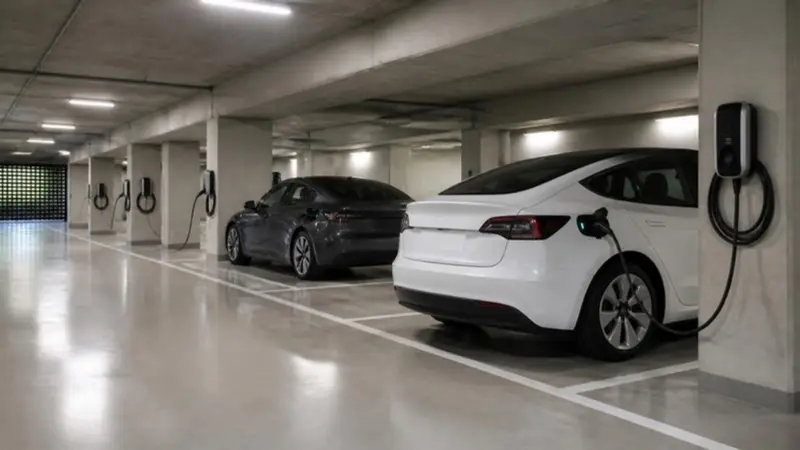
Many communities do both: owners may install chargers at assigned spaces, and the association adds a few shared chargers for everyone else.
Who Pays for Electricity
- The unit's own meter. The simplest option when the space is close to the unit's panel. The owner pays through their normal bill.
- A submeter or metered charger. The charger runs from a common circuit and the association bills the owner for measured use.
- Networked chargers with usage fees. Drivers pay by app or card, and the fees go back to the association. This is common for shared chargers.
- A flat monthly fee. Easy to run but less fair, so it's usually a short-term arrangement.
For Boards and Property Managers: A Planning Checklist
- Survey residents to see how many drive EVs now and expect to in the next few years.
- Check the building's electrical capacity. A load study shows how many chargers the service can support. Load management can stretch it a long way. See panel upgrades and load management.
- Plan for growth. Running conduit to more spaces during the first project costs far less than opening walls and paving again later.
- Adopt a written charging policy covering approvals, contractor requirements, insurance, metering, maintenance, removal and parking etiquette.
- Choose equipment with access control and billing if chargers will be shared.
- Look at funding. Federal credits largely ended in 2026, but check current programs. Our tax credits and rebates guide covers what's left.
Our apartment, condo and HOA charging page explains how local installers handle these projects, and larger lots may fit better with commercial EV charging stations.