The Short Answer
A hardwired charger is the better long-term choice for most homes. It allows the highest output (up to 48A), has no outlet to wear out or overheat, and is usually the manufacturer's preferred setup. A NEMA 14-50 outlet makes sense when you want to take the charger with you, swap chargers easily, or use a portable charging cord, provided the outlet is industrial-grade and correctly protected.
Either way, the circuit is the same kind of work, and it's the heart of any EV charger installation in Reynoldsburg.
Side-by-Side Comparison
| NEMA 14-50 outlet | Hardwired charger | |
|---|---|---|
| Max charging current | 40A (on a 50A circuit) | Up to 48A (on a 60A circuit) |
| Weak points | Receptacle and plug contacts can loosen or overheat | No plug or receptacle in the circuit |
| GFCI | Often required for the outlet under current code | Built into the charger |
| Portability | Unplug and take it or swap it | Needs an electrician to remove |
| Outdoor use | Needs an in-use weatherproof cover | Charger's own outdoor rating (NEMA 3R/4) |
| Cost | Similar circuit, plus a quality receptacle and possibly a GFCI breaker | Similar circuit, often slightly less material |
If You Choose an Outlet, Get These Details Right
- Use an industrial-grade receptacle. Inexpensive 14-50 receptacles are designed for ranges that rarely run at full load for hours. EV charging does, and low-quality receptacles are a known overheating point.
- Leave the charger plugged in. Receptacles aren't designed for daily plug-and-unplug cycles. Treat the plug as semi-permanent.
- Plan for GFCI. Recent editions of the National Electrical Code require GFCI protection for many 240-volt receptacles in garages and outdoors. That can mean a GFCI breaker, and some chargers can trip it. Your electrician applies the code edition your jurisdiction enforces.
- Set the charger to 40A or less on a 50A circuit, and never plug a 48A unit into a 14-50.
Why Most Installers Lean Hardwired
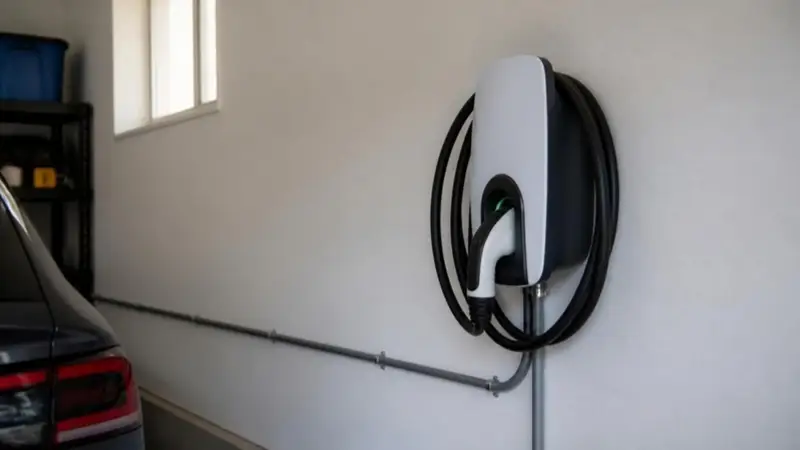
Hardwiring removes the two parts most likely to fail under hours of continuous current, the receptacle and plug. It also unlocks the full 48A output for vehicles that can use it, keeps ground-fault protection inside the charger where it's designed to work with the vehicle, and makes outdoor installations simpler. Many manufacturers, including Tesla for its Wall Connector, specify hardwired installation.
Which Should You Choose?
Choose a NEMA 14-50 if…
You rent or expect to move soon, you use a portable charging cord, you want to swap chargers without an electrician, and 40A is more than your car needs.
Choose hardwired if…
You own the home, want maximum output or an outdoor installation, want fewer failure points, or your charger's manufacturer recommends it.
Whichever you choose, the breaker and wire must match the charger. See what size breaker you need. Our Level 2 home charger installation page covers the rest of the process.