Stop First If You Notice Any of These
Don't keep charging if a plug, outlet, cable or charger is hot to the touch, discolored, melted, smells of burning, buzzes or sparks. Unplug only if it's safe, switch off the charger's breaker and call an electrician. These are signs of an overheating connection, which is a fire risk.
For everything else, work through the checks below. They solve a lot of problems without a service call. When they don't, a local installer offering EV charger installation and repair in Reynoldsburg can diagnose the rest.
Quick Checks to Try First
- Is the car set to charge? Check for a scheduled charging window, a departure-time setting or a charge limit that's already reached. These are the most common reasons a car "won't charge."
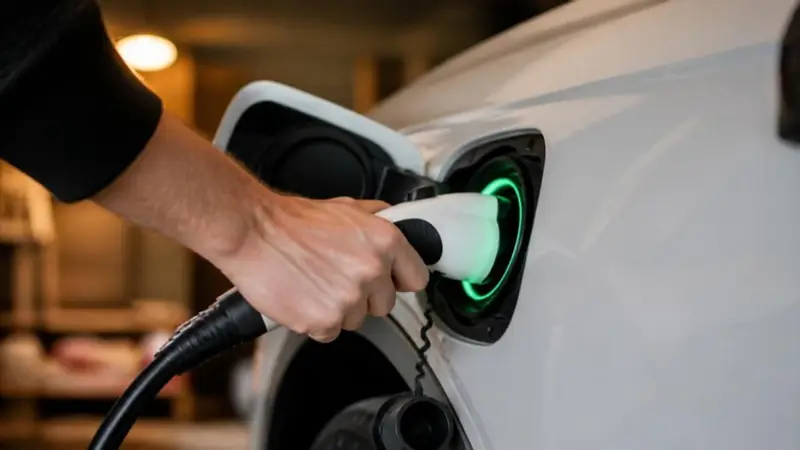
- Is the plug fully seated? Remove it and plug it back in firmly until the latch clicks. Look for debris, ice or damage in the connector and the car's charge port.
- Is the charger getting power? If its lights are off, check the breaker. A tripped breaker may sit in the middle position. Switch it fully off, then back on, once.
- Check the app. Many smart chargers show a fault message or a schedule in their app. A recent update or a time-zone change can alter the schedule.
- Restart the charger. Turn the breaker off for about a minute, then back on. This clears many temporary faults.
- Try another charger. If the car charges fine elsewhere, the problem is likely at home. If it won't charge anywhere, contact the vehicle's service center.
The Breaker Keeps Tripping
A breaker that trips once might be a fluke. One that trips repeatedly is telling you something. Don't keep resetting it.
- Charger set too high for the circuit. A charger drawing more than 80% of the breaker rating for hours will trip it. The setting needs to match the circuit. See our breaker size guide.
- Loose or overheating connection. Heat at the breaker, outlet or charger terminals can trip a breaker before anything visibly melts.
- A worn breaker. Breakers can weaken after years of heavy, continuous loads.
- Doubled-up ground-fault protection. A hardwired charger has its own ground-fault protection. Adding a GFCI breaker on top of it can cause nuisance trips.
- Another load on the same circuit. An EV charger should always have a dedicated circuit.
Ground-Fault or "GFCI" Errors
A ground-fault error means the charger detected current leaking somewhere it shouldn't. It's a safety shutdown, so treat it seriously. Common causes include:
- Moisture in an outdoor outlet, connector or charge port, often after rain, snow or a car wash
- A damaged cable that's been driven over, pinched in a door or chewed by rodents
- Wiring problems, such as a missing or loose ground
- Two layers of ground-fault protection reacting to each other, as described above
If the error keeps coming back after everything dries out, have the circuit tested. Outlet-based setups are more prone to these errors. Our comparison of NEMA 14-50 vs. hardwired chargers explains why.
Charging Is Slower Than It Should Be
- Cold weather. Ohio winters slow charging, especially at the start of a session, while the battery warms up. Charging in an attached garage or preconditioning the battery helps.
- A lower current setting. A reset, update or new installation can leave the charger, or the car's own current limit, set lower than the circuit allows.
- Heat. Many chargers reduce power when they get hot, for example in direct summer sun or with a worn connection.
- The car's limit. Your car's onboard charger caps AC charging speed. A bigger charger won't make it faster.
- Load management. If your home has a load-management device, it may be slowing charging while other appliances run. That's normal and intended.
- Charging on 120 volts. A Level 1 cord on a standard outlet adds only a few miles of range per hour. See Level 1 vs. Level 2.
Wi-Fi and App Problems
A charger that drops off Wi-Fi usually still charges. It just stops reporting or following its app schedule. Garages are often at the edge of Wi-Fi range, and a new router or password breaks the connection. Re-pair the charger in its app, move the router or add a mesh point near the garage, and check for firmware updates.
When to Call an Electrician or the Manufacturer
| Problem | Who to call |
|---|---|
| Heat, burning smell, melted or discolored parts | Stop charging and call an electrician |
| Breaker trips repeatedly | Electrician |
| Ground-fault errors that keep returning | Electrician |
| Charger has power but shows an internal fault code | Manufacturer support first (warranty), then an electrician |
| App, Wi-Fi or firmware issues | Manufacturer support |
| Car won't charge on any charger | Vehicle service center |
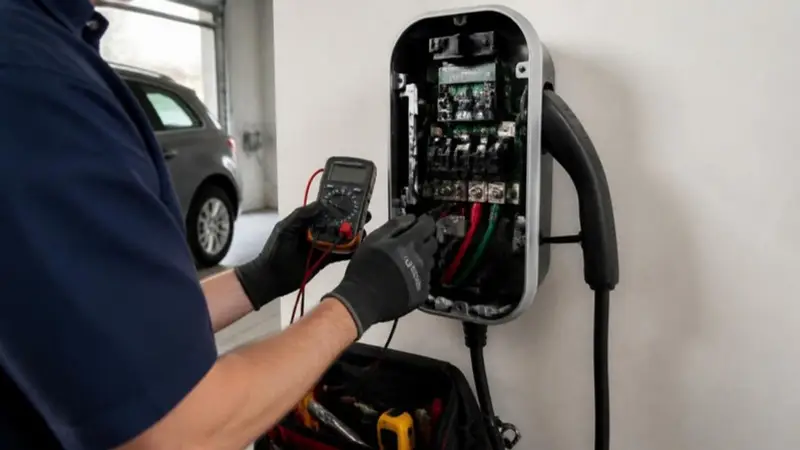
Before calling, note the charger's make and model, any fault code or light pattern, when the problem started, and whether anything changed recently, such as a new appliance, a storm or a power outage. Opening a charger yourself can void its warranty and exposes live 240-volt parts, so leave that to a professional.
Our EV charger repair and maintenance page covers what local technicians check and repair, including Tesla Wall Connectors and other Level 2 brands.