What Does EV Charger Repair Involve?
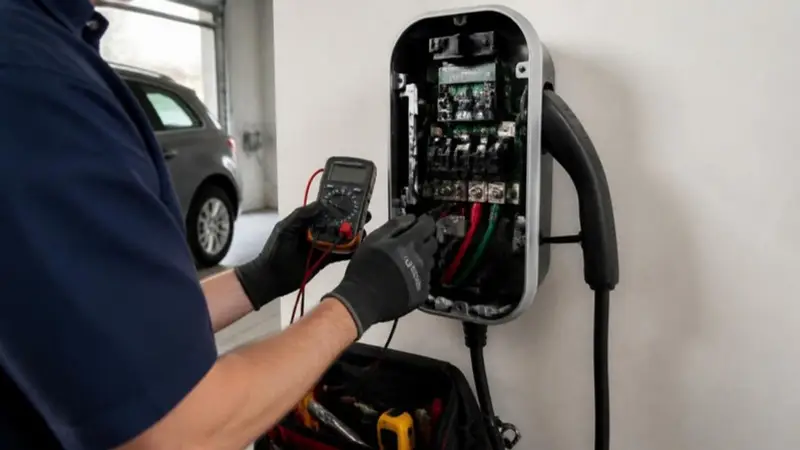
EV charger repair starts with diagnosing whether the problem is the circuit (breaker, wiring, connections, outlet), the charger (hardware fault, firmware, damaged cable or connector), the network (Wi-Fi, cellular or account settings), or the vehicle. A qualified electrician tests the circuit safely, reads fault codes, and repairs the wiring or coordinates warranty replacement of the charger.
Some charging problems are simple settings issues. Others, particularly heat damage at connections, are safety concerns. Repair and maintenance round out the EV charger installation services available in Reynoldsburg.
Common Symptoms and Likely Causes
| Symptom | Possible causes |
|---|---|
| Breaker trips during charging | Breaker undersized for the charger setting, loose or overheated connection, failing breaker, ground fault |
| GFCI trips repeatedly | Moisture, damaged cable, charger ground-fault detection conflict, outlet issue |
| Fault or red light on charger | Grounding problem, over-temperature, internal fault, communication error with the vehicle |
| Charging slower than expected | Current limit set low, vehicle charge limit or schedule, heat derating, power sharing active |
| Charger offline in the app | Weak Wi-Fi or cellular signal, router change, expired network subscription |
| Melted or discolored outlet or plug | Overheating connection or worn receptacle. Stop using it and turn off the breaker. |
Safe Checks Before You Call
- Look up the fault code or light pattern in the charger's manual or app.
- Check the vehicle's charge limit and scheduled charging settings, which often explain "not charging" complaints.
- Power-cycle the charger by switching its breaker off for a minute, then back on.
- Look for visible damage to the cable, connector or outlet without opening the charger.
- Note the charger's make, model and serial number, and when it was installed.
Don't open the charger, remove the panel cover or reset a breaker that trips again immediately. Those need an electrician.
Warranty: Hardware vs. Workmanship
Two separate warranties usually apply. The charger's manufacturer warranty covers the unit for a set period, and many manufacturers require that it was installed by a qualified electrician. The installer's workmanship warranty, if offered, covers the circuit and installation. If your charger is still under warranty, a technician can document the fault so you can file a claim with the manufacturer. Always confirm what a given installer covers and for how long.
Routine Maintenance and Service Contracts
Home chargers need little upkeep. Keep the connector clean and capped, hang the cable, and look for wear. A periodic check of terminations is reasonable for high-use circuits.
Commercial and fleet chargers benefit from scheduled maintenance: connector and cable inspection and replacement, cleaning and filter service on DC units, firmware updates, network health checks and payment-hardware testing. Maintenance contracts often include agreed response times, which matter for fleet operations and public-facing stations.
Repair or Replace?
Replacement often makes sense when the charger is out of warranty with a hardware fault, when you need a different connector (for example after switching to a NACS vehicle), or when you want more capacity. If the circuit was sized correctly, a new charger can often reuse it. If not, see Level 2 home charger installation or Tesla Wall Connector installation.
EV charger service is available across Reynoldsburg and neighboring areas like Pataskala and Blacklick. For installation and everything else, see our main guide to EV charger installation in Reynoldsburg, OH.